How Boiler Pressure Affects Home Heating Performance
Summary
- Understand how boiler pressure affects heating system efficiency and safety.
- Learn what normal boiler pressure should look like and why it matters.
- Identify the warning signs of excessively high or low boiler pressure.
- Explore common causes of pressure problems, including leaks and faulty components.
- Learn safe steps homeowners can take when boiler pressure becomes abnormal.
- Understand when professional boiler diagnostics and repairs may be necessary.
- Discover how proper boiler maintenance can support reliable heating and hot water in your Green Bay home.
When your home's heating system is not keeping up with a cold Green Bay winter, the problem may not be with the boiler's burner, heat exchanger, or thermostat. It may be with pressure. Boiler pressure too high or too low can significantly degrade heating performance, trigger safety shutdowns, and if left unaddressed cause serious damage to the system. At Garot Plumbing & Heating, we have been diagnosing and
repairing residential boiler systems throughout Green Bay, Wisconsin since 1946, and pressure-related issues are among the most common calls we receive from homeowners wondering why their heating and hot water is not working as expected.
What Is Boiler Pressure and Why Does It Matter?
A hot water boiler operates as a closed-loop system. Water is heated in the boiler, circulated through radiators or radiant floor tubing, and returned to be reheated. The pressure within this closed loop is critical: too little, and water will not circulate properly through the upper floors of the home; too much, and safety devices will activate to prevent damage or in worst cases, system components can fail under the stress.
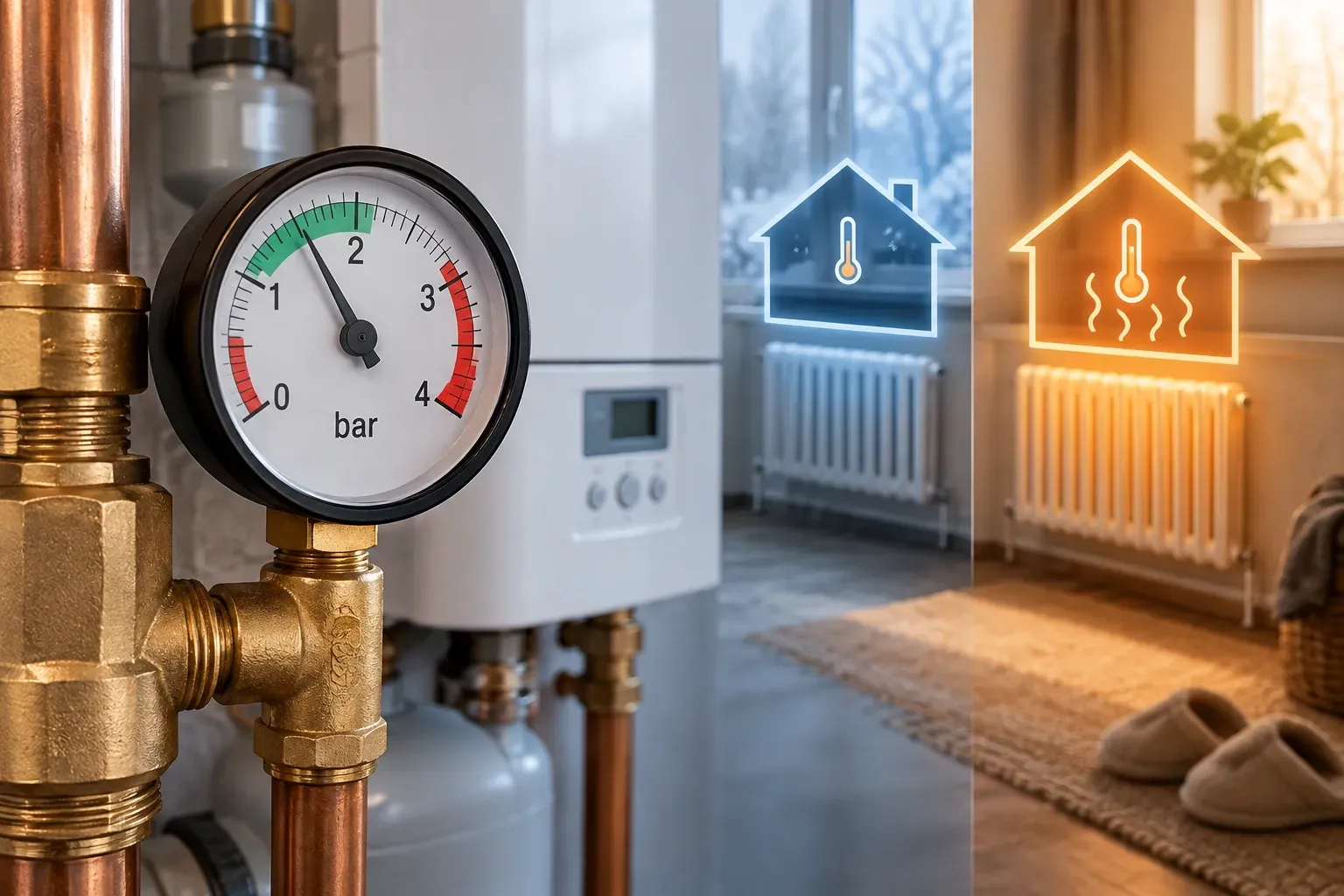
The boiler pressure gauge is the primary diagnostic tool for understanding the system's current state. On most residential hot water boilers, normal cold operating pressure falls between 12 and 15 PSI. When the system heats up, pressure rises to approximately 15 to 20 PSI. Readings consistently above 25 to 30 PSI indicate a problem that requires professional attention.
Signs of Boiler Pressure Too High
Boiler pressure too high is one of the more urgent pressure-related conditions because it places the entire system under mechanical stress and can trigger the pressure relief valve, the system's last line of defence against a catastrophic pressure buildup.
Common signs that pressure is elevated include:
- The boiler pressure gauge needle is in the red zone or above 30 PSI
- The pressure relief valve is dripping or discharging water near the boiler
- Heating and hot water not working despite the boiler appearing to run normally
- Banging or kettling sounds from the boiler or radiators
What causes high boiler pressure? The most common cause is a faulty or failed expansion tank. Every hot water boiler system includes an expansion tank, a small pressurized vessel that absorbs the increase in water volume as the system heats up. When the expansion tank fails or becomes waterlogged, there is no buffer for thermal expansion and system pressure climbs every time the boiler fires.
A failed boiler pressure valve (specifically the pressure relief valve) can also allow pressure to build without releasing it appropriately. Other causes include overfilling the system with water, a stuck fill valve, or a malfunctioning pressure-reducing valve on the makeup water line.
Signs of Low Water Pressure Boiler Problems
Low water pressure boiler conditions prevent adequate water circulation and are a very common reason for heating and hot water not working on the upper floors of a multi-story Green Bay home, even when the ground floor is warm.
Signs of low pressure include:
- The boiler pressure gauge reading below 10 PSI when cold
- Radiators on upper floors are cold while lower radiators heat normally
- The boiler fires but cycles off quickly without fully heating the home
- A persistent error code on modern boiler controls indicating low pressure
What causes low boiler pressure? The most frequent cause is a water leak either within the boiler itself, at radiator connections, at pipe joints, or at the pressure relief valve. Boiler pressure keeps dropping repeatedly after being topped up is a strong indicator of an active leak somewhere in the system that must be located and repaired before the pressure can be stabilized.
Air entrainment in the system can also reduce effective pressure and impair circulation. Bleeding radiators releasing trapped air through the bleed valve on each radiator — can restore proper circulation and is a routine maintenance task.
How to Fix Boiler Pressure Issues
Topping Up Low Pressure
Many modern boilers have a filling loop, a flexible braided hose with a valve that allows connection to the home's cold-water supply to add water to the system. The procedure involves slowly opening the filling loop valve, watching the gauge climb to the target pressure (typically 1.5 bar or 15 PSI), and then closing the valve. If boiler pressure keeps dropping within days or weeks of being topped up, there is a leak in the system that a licensed technician must locate and repair.
Reducing High Pressure
If pressure is elevated, do not attempt to release it by opening valves yourself unless you are certain of what you are doing. A
licensed plumber or heating technician should diagnose the cause of a failed expansion tank and address the root issue rather than simply bleeding pressure as a temporary measure. Replacing an expansion tank is a straightforward job for a professional and resolves most boiler pressure too high conditions permanently.
Fixing a Boiler Pressure Valve
The pressure relief valve is a safety device and should never be forced open, bypassed, or capped. If it is discharging water, this is the system telling you that pressure is exceeding safe limits. The underlying cause, not the valve, must be addressed. A relief valve that has been manually operated or has discharged repeatedly should be replaced, as the internal seat may no longer seal reliably.
When to Call a Professional
While checking the boiler pressure gauge and topping up a low-pressure system are tasks many homeowners can perform, the following situations require a licensed professional:
- Boiler pressure keeps dropping repeatedly despite being refilled
- The pressure relief valve is actively discharging
- Pressure is above 25 PSI and you cannot identify the cause
- Heating and hot water not working despite apparent normal boiler operation
- You suspect a leak anywhere in the system
Garot Plumbing & Heating provides boiler diagnostics, pressure system repair, expansion tank replacement, and full hot water boiler servicing for Green Bay homeowners. Our licensed technicians carry the parts and equipment to diagnose and resolve pressure issues in a single visit in most cases.
Conclusion
Boiler pressure is not a set-and-forget aspect of home heating, it is an ongoing indicator of system health that every homeowner should know how to read. Whether the issue is boiler pressure too high due to a failed expansion tank, low water pressure boiler conditions from a slow system leak, or a boiler pressure valve that is working overtime to compensate for an underlying problem, early diagnosis and professional repair protect your heating system investment and keep your Green Bay home warm when it matters most. Contact
Garot Plumbing & Heating to schedule a boiler inspection or pressure system diagnosis serving Green Bay, Wisconsin since 1946.
Frequently Asked Questions
1. What should my boiler pressure be when the system is cold?
For most residential hot water boilers, normal cold-start pressure falls between 12 and 15 PSI (approximately 1.0 to 1.5 bar on metric gauges). When the system heats up to operating temperature, pressure will naturally rise to 18 to 22 PSI. If your cold pressure reading is below 10 PSI or above 20 PSI, the system should be inspected by a licensed technician.
2. Why does my boiler pressure keep dropping?
Boiler pressure keeps dropping is almost always caused by a water leak somewhere in the system; this could be at a radiator valve, a pipe joint, the boiler itself, or at the pressure relief valve. In rare cases, a faulty pressure gauge or a failed automatic air vent can also cause apparent pressure loss. A licensed plumber will pressure-test the system and identify the source of the loss. Repeatedly topping up the system without finding and fixing the leak leads to corrosion and oxygen introduction that accelerates component wear.
3. Is boiler pressure too high and dangerous?
Elevated boiler pressure is a serious condition. Most residential systems have a pressure relief valve set to open at 30 PSI this prevents dangerous pressure buildup but indicates the system is operating beyond its normal range. A boiler running consistently at high pressure puts stress on all system components, including the heat exchanger, pipe connections, and radiator bodies. If your boiler pressure gauge is consistently reading in the red zone, do not ignore it and call a licensed technician promptly.
4. Can I fix boiler pressure myself?
Topping up a low-pressure boiler via the filling loop is something most homeowners can do safely by following the boiler manufacturer's instructions. Beyond that, boiler pressure repairs including replacing an expansion tank, repairing a boiler pressure valve, fixing a leak, or bleeding the system are best handled by a licensed professional. Incorrect intervention on a pressurized heating system can cause burns, flooding, or component damage.
5. Why is my heating and hot water not working even though the boiler is running?
If the boiler fires but heating and hot water is not working effectively, low pressure is a common cause insufficient pressure prevents water from circulating to upper floors or through all radiator circuits. Other causes include a faulty zone valve, a circulation pump failure, or air-locked radiators. A boiler pressure check is a logical first diagnostic step, and Garot Plumbing & Heating's technicians can diagnose the full system to identify the root cause efficiently.
