How Hard Water Affects Your Boiler Performance
Quick Answer
Hard water deposits a layer of mineral scale on your boiler's heat exchanger with every heating cycle. Even 1/16 of an inch of scale reduces heat transfer efficiency by 10–15%. In Green Bay, where water hardness is moderate to high, annual boiler maintenance — including descaling and inhibitor treatment — is the most cost-effective way to protect your heating system and keep energy costs in check.
Quick Summary
Hard water silently degrades boiler performance over time. This blog explains how it happens, what signs to watch for, and what Green Bay homeowners can do about it.
- Dissolved calcium and magnesium in hard water form scale on boiler heat exchanger surfaces.
- Scale reduces heat transfer, increases fuel consumption, and can cause heat exchanger failure.
- Kettling (rumbling/banging) is one of the most recognizable signs of scale buildup.
- Annual descaling, inhibitor treatment, and system flushing prevent most hard water damage.
- Whole-home water softeners address the problem at its source.
- Garot Plumbing & Heating provides complete boiler maintenance services for Green Bay homes.
Green Bay homeowners with hot water boiler heating systems face a challenge that many never connect to their heating bills or their annual service calls: hard water. The hard water effects on boilers are gradual but cumulative — and left unaddressed, they reduce efficiency, increase operating costs, and shorten the life of one of the most significant mechanical systems in your home. At Garot Plumbing & Heating, we have been servicing boiler systems throughout Green Bay, Wisconsin since 1946, and hard water damage is among the most consistent issues we diagnose during maintenance visits.
What Is Hard Water and Why Does It Affect Boilers?
Hard water contains elevated concentrations of dissolved minerals — primarily calcium and magnesium — that are naturally present in groundwater. Green Bay's water supply, like much of Wisconsin, has measurable hardness that affects plumbing fixtures, appliances, and heating equipment throughout the home.
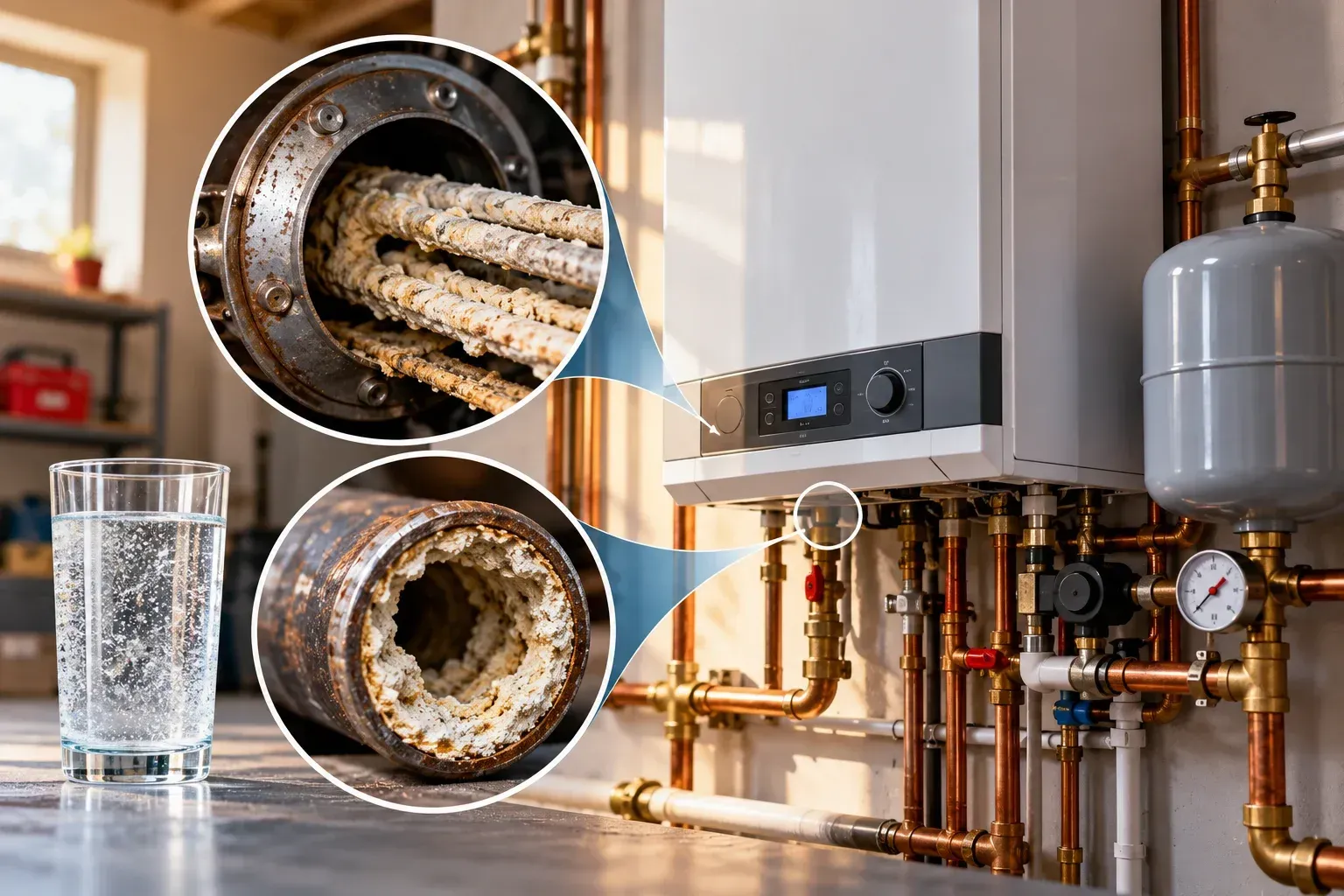
In a boiler system, water is repeatedly heated and circulated through a closed loop. Each heating cycle can cause dissolved minerals to precipitate out of the water and adhere to the interior surfaces of the boiler's heat exchanger, pipes, and components. Over time, this accumulation — known as boiler sediment buildup or scale — creates an insulating layer of mineral deposits that makes it harder for the boiler to transfer heat efficiently.
When scale buildup becomes excessive, it can contribute to reduced heating performance, unusual noises, higher energy consumption, and increased wear on boiler components. Professional
boiler repair services can help identify these issues, address underlying performance problems, and restore reliable heating operation. Garot Plumbing & Heating provides expert plumbing and heating solutions to help homeowners maintain their boiler systems, troubleshoot heating concerns, and determine whether cleaning, repairs, or other maintenance measures are needed to keep their equipment operating efficiently.
How Scale Reduces Boiler Efficiency
Scale is a remarkably effective insulator. Even a thin layer of mineral deposits — as little as 1/16 of an inch — can reduce boiler heat transfer efficiency by 10 to 15 percent. As the scale layer thickens over multiple heating seasons without intervention, efficiency losses compound.
| Scale Thickness | Estimated Efficiency Loss | Practical Impact |
|---|---|---|
| 1/16 inch | 10–15% | Slightly higher fuel bills |
| 1/8 inch | 20–25% | Noticeable heating performance drop |
| 1/4 inch | 30–40% | Significant fuel cost increase |
| 3/8 inch+ | 50%+ | Risk of heat exchanger failure |
The practical result for Green Bay homeowners is a boiler that runs longer to achieve the same water temperature, consuming more fuel and driving up heating costs each winter.
Beyond efficiency, hard water scale removal becomes urgent when deposits reach the point where they cause localized overheating of the heat exchanger. Without adequate water contact to absorb the burner's heat, metal surfaces can reach temperatures that cause stress fractures, warping, and eventually heat exchanger failure — one of the most expensive boiler repair scenarios.
Signs That Hard Water Is Affecting Your Boiler
Several warning signs suggest that scale buildup is already degrading your boiler's performance:
Reduced Heating Efficiency
If your home feels less warm than previous winters despite the thermostat setting remaining the same, or if your fuel consumption has noticeably increased, scale-related efficiency loss is a likely contributor.
Unusual Boiler Noises
A phenomenon called "kettling" — a rumbling or banging sound from the boiler during operation — is often caused by scale on the heat exchanger. Water becomes trapped beneath the scale layer, overheats, and creates steam and pressure fluctuations that produce the characteristic noise.
Expert Insight
During our annual boiler inspections across Green Bay, kettling is one of the first symptoms homeowners describe — often for years before they connect it to a maintenance need. In our experience, a boiler that has been kettling for two or more winters without service typically has significant scale accumulation and measurable efficiency loss. Catching it earlier means a simpler descaling job. Catching it later can mean a heat exchanger replacement. The economics of annual maintenance are not complicated.
—
Garot Plumbing & Heating, serving Green Bay since 1946
Mineral Deposits Visible Around Fittings
White or chalky residue around boiler connections, pressure relief valves, or radiator bleed points indicates that mineral-laden water is present throughout the system and that
mineral deposits in water heater and boiler components are accumulating.
Increasing Frequency of Service Calls
A boiler that previously ran reliably but now requires more frequent attention — pressure issues, circulation problems, thermostat irregularities — may be suffering the downstream effects of untreated scale buildup.
Boiler Maintenance Services: Addressing Hard Water Damage
The good news is that hard water scale is preventable and, in most cases, treatable before it causes irreversible damage. Effective boiler maintenance services for hard water conditions include:
Chemical Descaling
A licensed heating technician can add a chemical descaling agent to the boiler circuit that dissolves and loosens mineral deposits from the heat exchanger and pipe interiors. The system is then flushed to remove the dissolved scale. This process can restore meaningful efficiency in systems that have not been descaled in several years.
Inhibitor Treatment
After descaling, adding a corrosion and scale inhibitor to the boiler circuit creates a chemical barrier that reduces the rate at which new deposits form. Inhibitor levels should be checked and replenished annually as part of routine boiler maintenance services.
Water Softener Installation
For homes with particularly hard water, installing a whole-home water softener upstream of the boiler's makeup water connection addresses the problem at its source. Softened water has dramatically reduced mineral content, slowing scale accumulation across all hot water systems — boiler, water heater, and fixtures alike.
Annual System Flush and Inspection
Annual flushing of the boiler circuit removes accumulated debris, checks inhibitor levels, and allows a technician to assess the condition of the heat exchanger, pump, and expansion vessel before issues become failures. Garot Plumbing & Heating provides complete annual
boiler maintenance services for Green Bay homeowners, ensuring systems enter each heating season in optimal condition.
Conclusion
Hard water is a slow but serious threat to boiler performance and longevity. The hard water effects on boilers — reduced efficiency, kettle noise, heat exchanger stress, and accelerated component wear — are all preventable with consistent maintenance and the right water treatment approach. Garot Plumbing & Heating's licensed technicians have been protecting Green Bay homes' heating systems since 1946. Whether you need a one-time descaling, annual boiler maintenance, or guidance on a whole-home water softener installation,
contact us today and keep your boiler performing efficiently all winter long.
Frequently Asked Questions
How do I know if Green Bay's water is hard enough to damage my boiler?
Green Bay municipal water has moderate to high hardness, measured in milligrams per liter of calcium carbonate. Most utility suppliers publish annual water quality reports that include hardness figures. As a general guide, water above 120 mg/L (7 grains per gallon) is considered hard enough to warrant scale prevention measures in boiler systems. Garot Plumbing & Heating can assess your specific situation during a boiler inspection.
How often should a boiler be descaled in a hard water area?
In areas with moderate to high water hardness like Green Bay, a professional descaling every 2 to 3 years is a reasonable maintenance interval for most residential boilers, alongside annual inhibitor checks. Systems that have never been descaled and are showing efficiency loss may need more intensive treatment initially. Your technician can advise based on the actual scale condition observed during the service visit.
Can hard water cause my boiler to fail completely?
Yes, in severe cases. Extensive boiler sediment buildup on the heat exchanger can cause localized overheating that leads to stress fractures and heat exchanger failure. Replacing a heat exchanger is one of the most expensive boiler repairs — in many cases, the cost approaches or exceeds that of a new boiler. Regular maintenance to prevent this level of damage is far less costly than addressing it after the fact.
Will a water softener damage my boiler system?
Correctly installed water softeners are safe for boiler systems. The ion-exchange process that removes calcium and magnesium replaces them with sodium at very low concentrations — well within safe limits for boiler circuits. However, the softener must be properly sized and maintained to avoid introducing excessive sodium into the system. Garot Plumbing & Heating can advise on water softener selection and installation in the context of your specific heating setup.
What are the signs that my boiler needs a hard water scale removal service?
Key indicators include a kettling or rumbling sound during operation, higher fuel consumption than previous winters, slow heat delivery, reduced radiator performance on upper floors, and visible limescale around fittings or valves. If your boiler has not been serviced in more than two years and Green Bay's hard water is present in your supply, a descaling and inhibitor treatment is a sound preventive investment even in the absence of obvious symptoms.
